
ISO 27001 and Visitor Management Compliance
ISO 27001 and Visitor Management Compliance
Organizations often focus on digital security first, yet auditors also care about who can walk through the front door. That is where visitor management and physical access control become part of a stronger compliance posture.
ISO/IEC 27001 defines the requirements for an information security management system, while ISO/IEC 27002 provides practical guidance for implementing security controls. Therefore, both standards push organizations to think seriously about controlled physical entry, secure areas, and documented processes.
If you want the wider platform context first, review Sadevio’s features, available integrations, and the live self-service kiosk demonstration.
Why ISO/IEC 27001 and ISO/IEC 27002 matter at the front desk
Many compliance conversations start with policies, risk registers, and cybersecurity controls. However, compliance does not stop at the network edge. It also includes the offices, server rooms, reception areas, and secure spaces where people, systems, and sensitive information are physically located.
That is why the front desk matters. If a visitor can enter without the right checks, or if no one can prove who arrived and when, physical security controls become harder to enforce. In contrast, a structured visitor process helps security, facilities, and compliance teams show that entry is managed consistently.
- Who entered the site?
- Why were they there?
- Who approved the visit?
- What time did they arrive and leave?
- Did access match the visitor type and policy?
These are practical compliance questions, and a modern visitor management system helps answer them clearly.
Where visitor management supports compliance
A manual sign-in sheet can capture a name, but it rarely verifies identity, applies rules consistently, or creates clean audit evidence. Consequently, many organizations improve both security and audit readiness when they replace paper-based reception with a digital workflow.
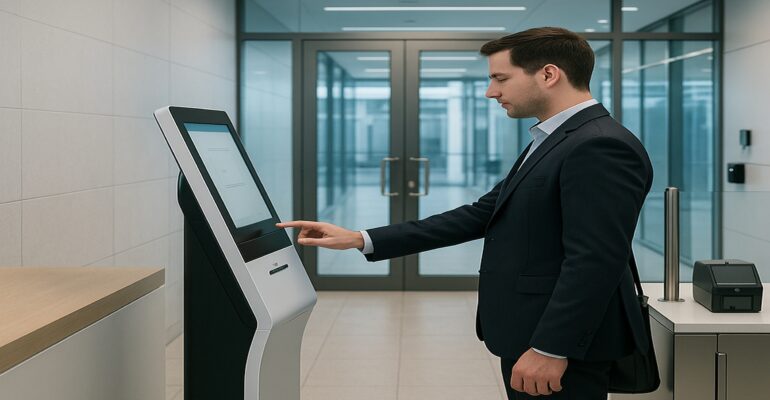
Moreover, when visitor management is connected to a self-service kiosk, the front desk becomes an automated control point instead of just a reception desk.
Controlled physical entry
A visitor management system helps apply the same entry standards every time. For example, visitors can be pre-registered, linked to a host, prompted to confirm their purpose, and routed through the right workflow before they move beyond reception.
As a result, access decisions become more consistent and less dependent on manual judgment at the desk.
Visitor identification and sign-in records
Compliance depends on evidence. A digital visitor management workflow records who checked in, when they arrived, who they were meeting, and when they left. Additionally, it can track badge issuance, acknowledgements, and other workflow steps that matter during internal reviews or external audits.
Access rules by visitor type
Not every visitor should follow the same path. Customers, candidates, contractors, vendors, and auditors often require different handling. Therefore, a modern visitor management platform can apply rules based on visit type, location, or policy.
That may include extra approvals, safety instructions, NDAs, escort requirements, or different badge workflows. In short, the process becomes easier to standardize across sites and shifts.
Audit evidence and reporting
Security teams often need more than a policy document. They need proof that the process is actually followed. Digital logs, timestamps, host notifications, and badge records help create that audit trail. Consequently, retrieving evidence becomes faster and more reliable than searching through paper logs or email chains.
Before vs after a digital visitor workflow
Before
- Visitors sign a paper log with limited verification.
- Reception staff call hosts manually.
- Badge handling varies by person or shift.
- Records are incomplete or difficult to review later.
After
- Visitors check in through a secure self-service kiosk.
- Host approval and visitor purpose are captured consistently.
- Badge and policy workflows follow the right rules.
- Digital logs support audits, reviews, and investigations.
That change matters because the front desk becomes both more secure and more efficient. Instead of slowing the lobby down, a well-designed workflow helps teams improve control without creating extra friction.
Example scenario: preparing for an ISO audit
Imagine a technology company preparing for an ISO audit. It has secure office areas, meeting rooms, and infrastructure spaces that should not be freely accessible to every guest. Before, visitors signed a notebook at reception. Hosts were notified manually, handwritten badges were used, and exit times were often missing.
After deploying a visitor management system with a self-service kiosk, the company standardizes the entire process. Visitors can pre-register before arrival, check in digitally on-site, accept site policies, and receive a time-stamped badge. Hosts get instant notifications, while contractors follow stricter workflows with extra approvals or escort rules.
In contrast to the old process, the organization can now show a clear and repeatable workflow. That does not guarantee certification on its own, of course. However, it supports the kind of physical access discipline and audit evidence that compliance teams expect to see.
What to look for in a compliance-focused visitor management system
If compliance is part of the business case, do not stop at simple sign-in. Instead, look for a platform that supports the full front-desk workflow.
- Self-service kiosk check-in for consistent visitor handling
- Visitor pre-registration and host approval workflows
- Digital logs with timestamps for arrivals and departures
- Badge printing and visitor-type rules
- Integrations with access control and notifications
- Policy acknowledgement, NDA, or safety prompts during check-in
- Reporting that helps teams retrieve audit-ready records quickly
At Sadevio, the biggest value comes when visitor management is treated as part of the automated front desk. The kiosk does more than welcome visitors. It helps enforce process, improve speed, and connect reception to the wider security workflow.
Key takeaways
- ISO/IEC 27001 and ISO/IEC 27002 both reinforce the importance of controlled physical entry.
- Visitor management helps standardize how visitors are identified, approved, and recorded.
- Digital logs create stronger audit trails than paper sign-in books.
- Self-service kiosks improve compliance support and visitor experience together.
- Integrated front-desk workflows make physical access control easier to enforce.
If your team wants to strengthen visitor handling while improving operational consistency, the front desk is a smart place to start. When visitor management, kiosk automation, and access workflows work together, compliance becomes easier to support in day-to-day operations.
Ready to modernize your front desk for compliance?
See how Sadevio can help your team create a secure, professional automated front desk with digital visitor management and stronger access workflows.